Показаны сообщения с ярлыком culture. Показать все сообщения

понедельник, 28 декабря 2015 г.

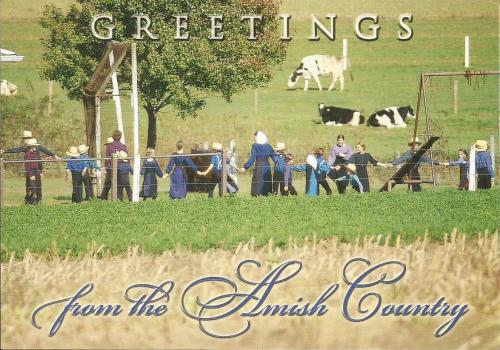
Greetings from Amish Country


Postcard IDUS-3558774
Country: USA

Some years ago one postcrossing card told me about Amish families. Before that time I had known nothing about them, even the name. So now, when I received this card I was prepared :)

Description from the postcard backside:
Amish children are often involved in group activities on recess. Here, they are playing 'Red Rover'.

воскресенье, 21 сентября 2014 г.

Sardines from Portugal


Postcard IDPT-376034
Country: Portugal

It's so nice to describe summer card in the autumn evening :) me and my husband are fans of  grilled fish.

Sardines are a common type of fish consumed by humans, as sardines are rich in nutrients. They are commonly served in cans, but fresh sardines are often grilled, pickled or smoked.

Sardines, or pilchards, are several types of small, oily fish related to herrings, family Clupeidae. The term sardine was first used in English during the early 15th century, and may come from the Mediterranean island of Sardinia, around which sardines were once abundant.

Sardines are commercially fished for a variety of uses: for bait; for immediate consumption; for canning, drying, salting, or smoking; and for reduction into fish meal or oil. The chief use of sardines is for human consumption, but fish meal is used as animal feed, while sardine oil has many uses, including the manufacture of paint, varnish and linoleum.

Here is a stamp from the card:

понедельник, 14 апреля 2014 г.

Beauty Girl from a Dream of the Red Mansions novel


Postcard IDCN-1239697
Country: China

Dream of the Red Chamber, composed by Cao Xueqin, is one of China's Four Great Classical Novels. It was written sometime in the middle of the 18th century during the Qing Dynasty. It is considered a masterpiece of Chinese literature and is generally acknowledged to be the pinnacle of Chinese fiction. "Redology" is the field of study devoted exclusively to this work.

The title has also been translated as Red Chamber Dream and A Dream of Red Mansions. The novel circulated in manuscript copies with various titles until its print publication, in 1791. The novel is also often known as The Story of the Stone. While the first 80 chapters were written by Cao Xueqin, Gao E, who prepared the first and second printed editions with his partner Cheng Weiyuan in 1791-2, added 40 additional chapters to complete the novel.

Red Chamber is believed to be semi-autobiographical, mirroring the rise and decay of author Cao Xueqin's own family and, by extension, of the Qing Dynasty. As the author details in the first chapter, it is intended to be a memorial to the women he knew in his youth: friends, relatives and servants. The novel is remarkable not only for its huge cast of characters and psychological scope, but also for its precise and detailed observation of the life and social structures typical of 18th-century Chinese aristocracy.

Here is also beautiful stamp, but I don't known its sense:

среда, 2 апреля 2014 г.

An ancient Chinese girl


Postcard IDCN-1240096
Country: China

Here is one more card from so enigmatic China for me.
For Europeans many Chinese girls look like with the same face. I think it works and vise versa. However when I watching moviese with Chinese actress I can see the difference. And I like to see on the beautiful Chinese girls. Like on this card :)

As usual, Chinese stamps are big and awesome:


воскресенье, 30 марта 2014 г.

Beijing Opera


Postcard ID: CN-1227173
Country: China

This card shows us one of the character in the Beijing Opera.
Beijing opera is a form of traditional Chinese theater which combines music, vocal performance, mime, dance, and acrobatics. It arose in the late 18th century and became fully developed and recognized by the mid-19th century. The form was extremely popular in the Qing Dynasty court and has come to be regarded as one of the cultural treasures of China. Major performance troupes are based in Beijing and Tianjin in the north, and Shanghai in the south.

Beijing opera features four main types of performers. Performing troupes often have several of each variety, as well as numerous secondary and tertiary performers. With their elaborate and colorful costumes, performers are the only focal points on Beijing opera's characteristically sparse stage. They utilize the skills of speech, song, dance, and combat in movements that are symbolic and suggestive, rather than realistic. Above all else, the skill of performers is evaluated according to the beauty of their movements. Performers also adhere to a variety of stylistic conventions that help audiences navigate the plot of the production. The layers of meaning within each movement must be expressed in time with music. Melodies include arias, fixed-tune melodies, and percussion patterns.

As usual, Chinese stamps are incredible!